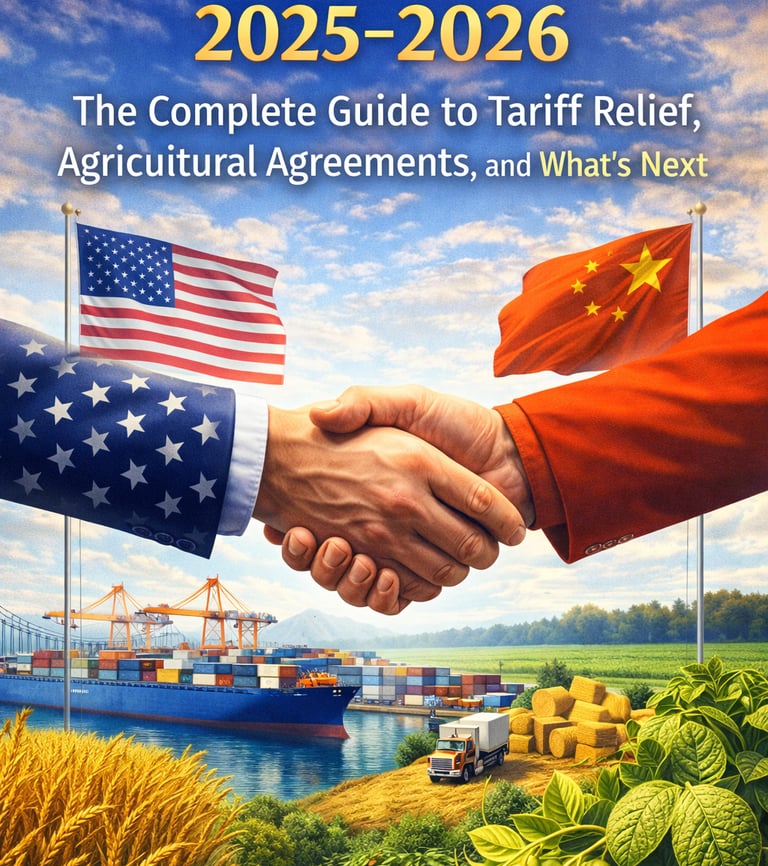
US-China Trade Deal 2025-2026: The Complete Guide to Tariff Relief, Agricultural Agreements, and What's Next
Last Updated: January 14, 2026
Executive Summary
The United States and China have reached a landmark one-year trade agreement that marks the most significant de-escalation in their trade war since 2018. After months of tariff escalation that saw rates hit unprecedented levels of 145% on some goods, both nations agreed in November 2025 to a comprehensive deal running through November 10, 2026.
Key Highlights:
US tariffs reduced from 145% to approximately 30% on Chinese goods
China suspended all retaliatory tariffs imposed since March 2025
$12 million metric tons of US soybean purchases committed for late 2025
25 million metric tons annual soybean purchases committed for 2026-2028
China suspended rare earth export controls for one year
178 tariff exclusions extended through November 2026
This comprehensive analysis examines the journey from crisis to compromise, what the deal means for businesses and consumers, and the critical challenges ahead as we move through 2026.
Table of Contents
From Crisis to Compromise: The 2025 Trade War Timeline
February-April 2025: The Escalation
When President Trump returned to office in January 2025, he moved quickly on his trade agenda. By February 4, he imposed 10% tariffs on all Chinese imports under the International Emergency Economic Powers Act, citing concerns about fentanyl precursor chemicals flowing from China.
China responded immediately with retaliatory measures. What followed was a rapid escalation that shocked global markets:
February 4: US imposes 10% IEEPA tariffs on China
March 4: Tariffs increased to 20% (fentanyl-related)
April 2: "Liberation Day" – US implements reciprocal tariffs reaching 34%
April-May: Tariffs escalate to 145% (US) and 125% (China)
The peak came in early May when the effective US tariff rate on Chinese goods hit 127.2%, while China's retaliatory tariffs reached 125%. Global supply chains buckled, stock markets plunged, and economists warned of a potential global recession.
May 2025: The Geneva Breakthrough
After five phone calls between Presidents Trump and Xi, U.S. Treasury Secretary Scott Bessent and Chinese Vice Premier He Lifeng met in Geneva on May 12, 2025. The breakthrough was dramatic:
Both nations agreed to reduce tariffs to just 10% for 90 days to allow for broader negotiations. Markets soared on the news, with the S&P 500 jumping nearly 3% in a single day.
Summer 2025: Building Trust
The 90-day truce was extended in August for another 90 days, signaling that both sides were making progress. Behind the scenes, negotiators worked on a more comprehensive framework.
October-November 2025: The One-Year Deal
On October 30, 2025, Presidents Trump and Xi met in Busan, South Korea, during Trump's Asia tour. The meeting produced the framework for what would become the comprehensive one-year trade deal announced in November 2025.
The agreement, formalized through White House fact sheets and executive orders on November 1-4, 2025, addressed far more than just tariff rates.
What's Actually in the November 2025 Deal
Tariff Reductions
US Commitments:
Reduced fentanyl-related tariffs from 20% to 10%
Maintained the 10% reciprocal tariff through November 10, 2026
Extended 178 Section 301 tariff exclusions until November 10, 2026
Suspended implementation of the "50% Affiliates Rule" for one year
Postponed maritime/shipbuilding sector tariffs for one year
China Commitments:
Suspended all retaliatory tariffs announced since March 4, 2025
Removed tariffs on US agricultural products including chicken, wheat, corn, cotton, sorghum, soybeans, pork, beef, seafood, fruits, vegetables, and dairy
Agricultural Purchase Commitments
China agreed to substantial US agricultural purchases:
2025: 12 million metric tons of soybeans (November-December)
2026-2028: 25 million metric tons of soybeans annually
Resumed purchases of US sorghum, hardwood logs, and softwood logs
These commitments represent billions of dollars in guaranteed exports for American farmers.
Critical Minerals and Rare Earths
Perhaps the most strategic element of the deal involves rare earth minerals:
China suspended global export controls announced October 9, 2025
Issued general licenses for exports of rare earths, gallium, germanium, antimony, and graphite
Effectively removed controls imposed since 2023
Valid for US end users and their global suppliers
This was critical because rare earths are essential for everything from smartphones to military aircraft, and China controls approximately 70% of global production.
Fentanyl Cooperation
China committed to:
Stop shipments of certain precursor chemicals to North America
Strictly control exports of other chemicals globally
Enhanced law enforcement cooperation
Technology and Semiconductors
China agreed to:
Terminate antitrust investigations targeting US semiconductor companies
End anti-monopoly probes against American firms
Remove sanctions on various US shipping entities
Extend tariff exclusion processes until December 31, 2026
Current Tariff Rates and How They Stack
Understanding current US-China tariff rates requires navigating a complex system of overlapping measures. As of January 2026, here's what applies:
For Most Chinese Goods Entering the US:
Base Components:
Most Favored Nation (MFN) rate: ~2-5% (standard baseline)
Section 301 tariffs: 7.5% to 25% (depending on product category)
Fentanyl-related tariff: 10% (reduced from 20%)
Reciprocal tariff: 10% (suspended increase through Nov 2026)
Effective Rate: Approximately 29.3% average (down from 47.5% before the deal)
Special Cases:
Products with Tariff Exclusions (178 items): These items are exempt from some Section 301 tariffs and include:
Solar manufacturing equipment
Medical devices
Certain machinery components
Specific vehicle parts
Industrial materials
Sector-Specific Tariffs:
Steel and aluminum: 50% (Section 232)
Electric vehicles: Up to 100% (combined Section 301 + IEEPA)
Some semiconductors: Various exclusions apply
Wood furniture: 30% (increasing from January 2026)
Kitchen cabinets: 50% (from January 2026)
For US Goods Entering China:
General tariff rate: 21.9% (down from over 100% during peak escalation)
Many agricultural products: 0% (tariffs suspended)
Market-based exclusion process extended through December 31, 2026
Winners and Losers: Industry Impact Analysis
Clear Winners
Agriculture
American farmers, particularly in the Midwest, are the biggest winners. The combination of eliminated Chinese tariffs and guaranteed purchase commitments provides stability after years of lost sales.
Soybean farmers alone will benefit from commitments worth an estimated $7-10 billion annually. Pork, beef, and dairy producers also gain significant market access.
Technology Companies
Major tech firms saw immediate stock price gains. Apple, Tesla, Amazon, and others with complex China-based supply chains benefit from:
Lower component costs
Removal of semiconductor investigations
Suspension of export control expansions
Greater operational certainty
Rare Earth-Dependent Industries
The suspension of rare earth export controls is crucial for:
Defense contractors
Electronics manufacturers
Electric vehicle producers
Renewable energy companies
These industries had faced potential supply disruptions that could have crippled production.
Mixed Impact
Manufacturing
The picture is complicated for manufacturers. Those that relocated production in response to earlier tariffs now face difficult decisions:
Should they move back to China? (Expensive and risky given the one-year timeframe)
Should they maintain diversified supply chains? (More expensive but safer)
How do they plan for potential re-escalation?
Companies that never left China benefit from lower costs, but face competitive disadvantages versus those who diversified.
Retailers and Importers
Retailers see some cost relief but still face tariffs far higher than historical levels. A typical Chinese-made consumer product might still face 20-30% in combined tariffs versus 2-3% in 2017.
This means prices won't return to pre-trade-war levels, limiting consumer benefits.
Losers
US Manufacturers Protected by Tariffs
Industries that had benefited from tariff protection face renewed Chinese competition:
Steel producers
Some aluminum manufacturers
Textile makers in protected categories
These industries lobbied hard against tariff reductions and may push for exemptions or new protective measures.
Compliance Professionals
While not a traditional "loser," the complexity created by overlapping tariff regimes means companies must invest heavily in:
Trade compliance expertise
Customs classification specialists
Legal review of product-specific exemptions
Supply chain auditing
The 4,500+ page US Harmonized Tariff Schedule for 2026 reflects this bewildering complexity.
Agricultural Trade: The Soybean Commitments Explained
The agricultural provisions represent one of the deal's most concrete elements. Here's what they mean in practice:
The Numbers
2025 Commitment (Nov-Dec):
12 million metric tons of US soybeans
Worth approximately $5-6 billion at current prices
Represents roughly 20% of annual US soybean production
Annual Commitment (2026-2028):
25 million metric tons per year
Worth approximately $10-12 billion annually
Equals about 40% of typical US soybean exports
Why This Matters
Before the trade war, China was the world's largest soybean importer and the US was its primary supplier. At the peak of trade in 2017, China purchased over 30 million metric tons of US soybeans.
During the trade war, China shifted to Brazilian and Argentine suppliers, devastating US farmers. Iowa, Illinois, and Minnesota farmers saw exports crater and prices plummet. Many farms that had operated for generations faced bankruptcy.
The guaranteed purchase commitments provide:
Price stability for planning purposes
Renewed market access to China's massive demand
Competitive positioning against South American suppliers
Beyond Soybeans
China also committed to resuming purchases of:
Sorghum: Used primarily for animal feed in China
Hardwood and softwood logs: Important for Pacific Northwest timber producers
Other agricultural products with removed tariffs
Implementation Questions
Key questions remain about implementation:
How will purchases be distributed among US exporters?
What happens if China falls short (as it did with Phase One commitments)?
How will Brazilian suppliers respond to reduced Chinese demand?
Can US farmers ramp up production fast enough?
Rare Earth Minerals and Technology Transfer
The technology and critical minerals provisions address some of the trade war's most strategic dimensions.
The Rare Earth Problem
China controls approximately 70% of global rare earth mining and over 90% of rare earth processing. These materials are essential for:
Permanent magnets in electric vehicles
Defense systems including missiles and fighter jets
Wind turbines for renewable energy
Smartphones, computers, and consumer electronics
Medical imaging equipment
In October 2025, China announced sweeping export controls on these materials, threatening to cut off global supply. The timing appeared designed to maximize leverage before the Trump-Xi meeting.
The US faced a potential crisis: domestic rare earth production is minimal, and alternative suppliers like Australia and Canada would need years to scale up.
The Deal's Solution
China's agreement to suspend these controls and issue general licenses means:
US companies can continue accessing Chinese rare earths
Global supply chains remain intact
Defense contractors avoid critical shortages
Time to develop alternative sources
However, the one-year timeframe means this remains a point of leverage China could use if negotiations fail to produce a longer-term agreement.
The "50% Affiliates Rule"
The deal also suspended the "50% Affiliates Rule" for one year. This US regulation would have subjected subsidiaries of companies on export control lists to US restrictions, even if located outside the US.
The suspension provides relief to global companies with complex ownership structures and Chinese partnerships, though it represents a US concession on export controls.
Semiconductor Investigations
China agreed to terminate several investigations targeting US semiconductor companies:
Antitrust probes against major chipmakers
Anti-monopoly investigations
Anti-dumping inquiries
These investigations had threatened to exclude US companies from the Chinese market or impose heavy fines. Their termination removes significant legal risk.
<a name="new-threats"></a>
New Threats Emerging in 2026
Despite the November deal, new tensions have emerged that threaten the fragile trade truce:
Iran Tariffs
On January 13, 2026, President Trump announced 25% tariffs on countries doing business with Iran. This creates an immediate problem: China is Iran's largest trading partner and oil customer.
China imported over $28 billion in crude oil from Iran in 2024. Simply walking away from this relationship is economically and strategically impossible for Beijing.
Chinese officials warned they would take "all necessary measures" to defend their interests, raising the specter of renewed retaliation. This could quickly unravel the November agreement.
Beef Tariffs
Starting January 1, 2026, China implemented new 55% tariffs on US beef imports exceeding quota limits. While officially framed as protecting domestic producers, the timing sends a message about China's willingness to use trade tools.
The three-year tariff demonstrates that even within the broader agreement, specific disputes continue.
Supreme Court Challenge
The US Supreme Court is expected to rule soon on whether President Trump's use of the International Emergency Economic Powers Act (IEEPA) to impose tariffs is constitutional.
A ruling against the administration could invalidate much of the current tariff structure. However, legal experts note that the administration could likely recreate similar measures using other legal authorities like Section 232 (national security) or Section 301 (unfair trade practices).
Still, a negative ruling would create significant uncertainty and could require months to reconstruct the tariff framework.
USMCA Renegotiation
The United States-Mexico-Canada Agreement (USMCA) is up for review in 2026. Negotiations could become contentious, particularly around:
Chinese content in Mexican-assembled vehicles
Rules of origin for automotive parts
Agricultural trade disputes
Canadian digital services taxes
Failure to reach agreement could threaten North American free trade, with significant implications for supply chains that have been configured around USMCA provisions.
<a name="business-guide"></a>
What Businesses Need to Know Right Now
For companies navigating this complex environment, here's practical guidance:
Immediate Action Items
1. Audit Your Tariff Exposure
Conduct a comprehensive review of:
Which products face which tariff categories
Whether any items qualify for exclusions
Total annual tariff costs under current rates
Potential savings if exclusions can be obtained
The USTR's tariff exclusion database and the US International Trade Commission's tariff lookup tool are essential resources.
2. Evaluate Supply Chain Options
Companies should scenario-plan for:
Status quo continues: Current reduced tariffs remain through November 2026
Deal extends: Tariffs stay low or decrease further
Deal collapses: Return to 100%+ tariff rates
For each scenario, what are your optimal supply chain configurations?
3. Monitor Exclusion Opportunities
The 178 extended exclusions cover items like:
Solar manufacturing equipment
Medical devices
Certain machinery components
Specific vehicle parts
Companies should review whether their products qualify or whether similar products suggest a path to requesting new exclusions.
4. Consider Front-Loading
If you anticipate potential tariff increases, you might consider:
Building inventory ahead of potential tariff snapback
Accelerating purchases while rates are lower
Negotiating long-term contracts at current rates
However, this ties up working capital and creates warehousing costs.
Medium-Term Strategy
Diversify Manufacturing
The one-year deal timeframe suggests prudence in maintaining manufacturing diversification:
Vietnam: Increasingly popular for electronics, textiles, footwear
India: Growing capacity in pharmaceuticals, textiles, electronics
Mexico: Proximity for automotive, appliances, nearshoring
Other Southeast Asia: Thailand, Indonesia, Malaysia for various manufacturing
Companies that shifted production in 2018-2020 should carefully evaluate whether the cost savings from moving back to China justify the risk of potential future escalation.
Develop Dual Sourcing
Rather than all-in on one location, many companies are adopting dual or multiple sourcing strategies:
Primary production in China for Chinese market
Alternative production elsewhere for US/global markets
Ability to shift volumes based on tariff environment
This costs more than single-source efficiency but provides risk management.
Invest in Compliance Infrastructure
The complexity of current tariff rules requires investment in:
Experienced customs brokers
Trade compliance software
Legal expertise for classification disputes
Regular training for procurement and logistics teams
Political Risk Management
Track the Negotiation Timeline
Key dates to monitor:
April-May 2026: Likely renewed negotiations as November deadline approaches
July 2026: Potential point for extension or escalation discussions
November 10, 2026: Current deal expiration date
Businesses should track statements from both governments for signals about extension or breakdown.
Maintain Government Relations
Companies significantly affected should:
Engage with industry associations to advocate positions
Participate in public comment periods on tariff exclusions
Brief congressional representatives on impacts
Monitor and respond to USTR investigations and notices
Develop Communication Plans
Have clear communication strategies ready for:
Investors concerned about tariff impact on margins
Customers facing potential price increases
Employees in affected manufacturing locations
Media inquiries about company response
Frequently Asked Questions
Q: Are US-China tariffs completely eliminated?
No. While significantly reduced from peak levels, substantial tariffs remain. Most Chinese goods entering the US still face approximately 29-30% in combined tariffs, far above the 2-3% pre-trade-war levels.
Q: When does the current deal expire?
The main provisions expire November 10, 2026. Some elements (like China's exclusion process) extend to December 31, 2026.
Q: What happens if the deal isn't extended?
Without extension or a new agreement, tariffs could snap back to previous levels or escalate further. This creates significant uncertainty for 2026 planning.
Q: How do I find out if my product qualifies for a tariff exclusion?
Check the USTR's Section 301 exclusion database and consult with a customs broker or trade attorney. The 178 extended exclusions are listed in Federal Register notices.
Q: Did China meet its Phase One purchase commitments?
No. Under the 2020 Phase One agreement, China committed to purchase $200 billion in additional US goods. They fell short by approximately 60%, purchasing only about $80 billion of the committed amount.
Q: Will consumer prices go down?
Some modest price reductions may occur on electronics and other Chinese imports, but prices won't return to pre-2018 levels because significant tariffs remain in place.
Q: What are the most likely scenarios for 2026?
Analysts see three main possibilities:
Extension: Deal extended beyond November with minor modifications (40% probability)
Partial escalation: Some tariffs increase while core agreement continues (35% probability)
Breakdown: Return to high tariff environment (25% probability)
Q: Should I shift production back to China?
This depends on your specific situation, but most experts counsel caution. The one-year timeframe and political uncertainty suggest maintaining some supply chain diversification even if returning some production to China makes economic sense.
Q: How does this affect tariffs on goods from Hong Kong?
Goods from Hong Kong generally receive the same tariff treatment as goods from China for purposes of these trade measures.
Q: Where can I find the most current tariff rates?
The US International Trade Commission's Harmonized Tariff Schedule (HTS) database provides official rates. The Peterson Institute for International Economics maintains helpful charts of US-China tariff changes.
Conclusion: Navigating Uncertainty Through 2026
The US-China trade relationship has moved from the brink of complete breakdown to a fragile but functional truce. The November 2025 one-year deal provides breathing room for businesses and consumers, reduces economic uncertainty, and creates space for deeper negotiations.
However, the fundamental tensions that sparked the trade war remain unresolved. Both nations continue to view their economic relationship through the lens of strategic competition. Issues like industrial subsidies, technology transfer, market access, and geopolitical competition in the Indo-Pacific region ensure continued friction.
For businesses, the watchword is flexibility. Companies that can adapt quickly to changing tariff environments, maintain multiple sourcing options, and stay informed about policy developments will navigate this period most successfully. Those that assume stability or make irreversible commitments based on the current environment risk being caught off guard by potential future escalation.
The coming months will reveal whether the November 2025 agreement represents a genuine turning point toward more stable trade relations or merely another chapter in an ongoing cycle of escalation and temporary de-escalation. Either way, the era of predictable US-China trade policy is clearly over, replaced by an environment where companies must expect and plan for continued volatility.
Reach US :
Inspire
contact@thewideangle.blog
© 2025. All rights reserved.